
Boost Customer Retention with Launched's AI-Powered Win-Back CampaignsWin Back Lapsed Customers: AI Strategies to Boost SMB Revenue — Even on a Tight Budget
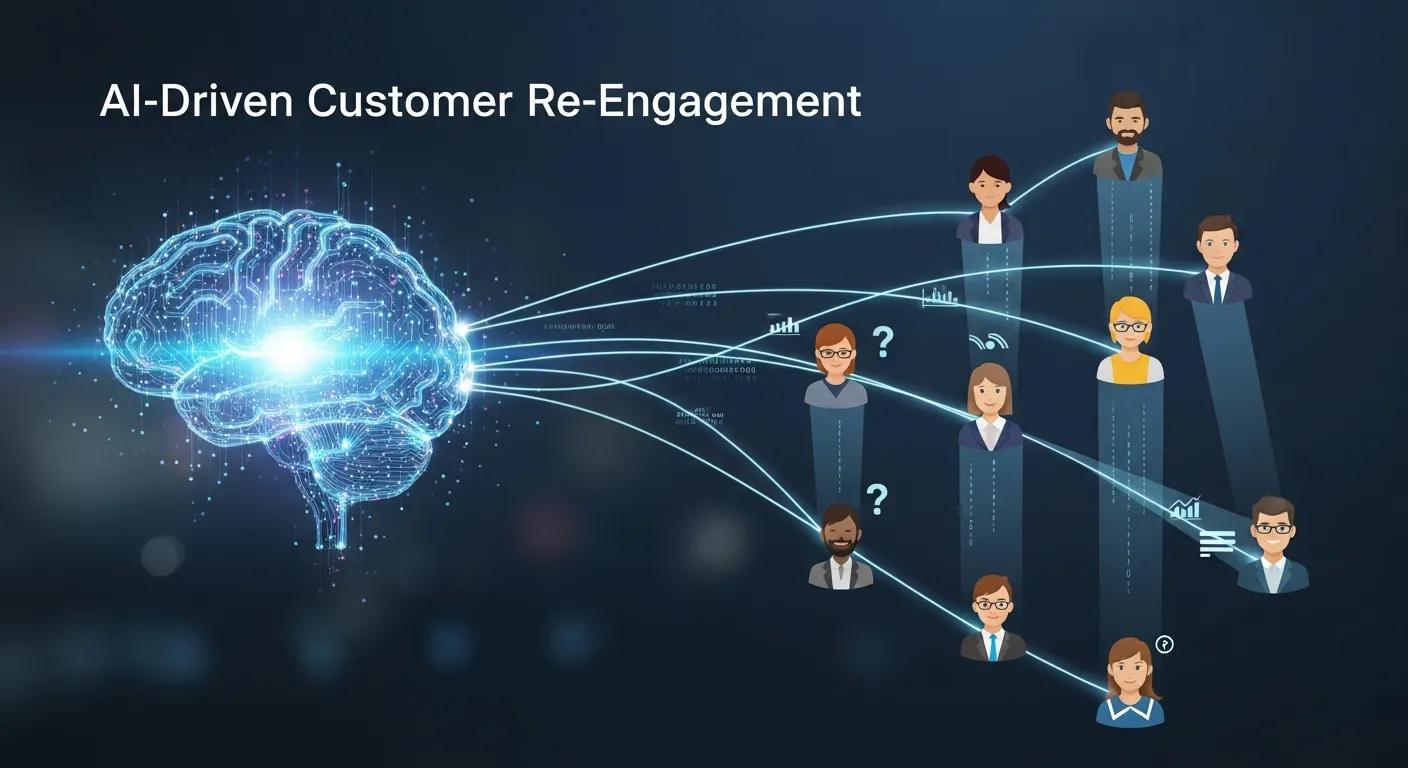
AI-powered win-back campaigns pair predictive scoring with automated outreach to re-engage lapsed customers and reclaim revenue. This guide walks through the tools that make it possible, how they identify lapsed buyers, and the role of conversational AI and orchestration engines in running automated re‑engagement. You’ll see which campaign types deliver the best outcomes, how to measure success with consistent KPIs, and practical implementation advice to avoid common pitfalls. We also include recent case patterns and forward-looking tactics — real-time decisioning, privacy-safe personalization, and more — so you can apply these strategies immediately. By the end, you’ll have templates, checklists, and measurement frameworks to turn AI outputs into repeatable win-back playbooks.
What Are AI Customer Retention Tools and How Do They Work?
AI customer retention tools are a set of software components — predictive models, orchestration engines, and conversational bots — that together score risk, segment lapsed contacts, and automate personalized outreach. Predictive churn models use recency, frequency, and monetary (RFM) data, along with engagement signals, to produce a risk or reactivation score that informs segmentation and campaign eligibility. Orchestration engines translate those signals into scheduled, multichannel workflows, while conversational AI runs two‑way dialogues that qualify intent and surface offers. Combined, these systems reduce manual effort and boost recovery efficiency by delivering the right message at the right time and channel. Understanding these building blocks makes it clear when to use each tool in a win-back program and how they connect to downstream metrics like recovery rate and CLV uplift.
Below is a quick comparison to clarify common tool types, core capabilities, and where each fits in a win-back campaign.
Use predictive scoring to prioritize, orchestration to automate, and conversational AI to convert high-intent lapsed customers into retained ones.
How Does Predictive Analytics Identify Lapsed Customers?
Predictive analytics detects lapsed customers by turning behavioral and transactional signals into churn or reactivation probabilities that determine eligibility for win-back flows. Models typically use RFM features, engagement signals (opens, clicks, logins), and product-affinity embeddings to produce a score or decile that maps to campaign tiers. For example, top-decile churn-risk customers with high CLV may get concierge outreach, while mid-risk segments receive automated discounts. Feature engineering matters: combining event recency with product-view patterns and past offer responsiveness improves prediction accuracy. A clean mapping from score to action prevents noisy outreach and focuses resources where recovery ROI is highest.
These model outputs directly inform channel choice and message type, which we cover next in the conversational AI section.
What Role Does Conversational AI Play in Automated Re-Engagement?
Conversational AI is the interactive execution layer in win-back campaigns: it guides customers through a short qualification and offer flow that boosts conversion through two‑way personalization. A typical path looks like greeting → context recall (why they left) → tailored offer → commitment or hand-off, with personalization tokens (last purchase, product interest) woven into the script. Bots can qualify intent, surface incentives, book appointments, or escalate to human agents when negotiation is needed, cutting friction and improving response rates. Capturing conversational transcripts in the CRM closes the loop for attribution and model retraining. Paired with predictive scoring, conversational AI focuses live interactions on high-value lapsed customers most likely to convert.
This layer also supports A/B testing of offers and message variants so you can refine personalization and maximize ROI.
Which Automated Re-Engagement Campaigns Deliver the Best Results?

High-performing re-engagement programs combine predictive prioritization with conversational outreach, triggered email flows, and targeted SMS for urgent offers. Channels differ by permission and immediacy: email scales for rich content and sequencing, SMS drives urgency, and chat or in-app messaging enables interactive recovery. The best campaigns map channel to segment and adapt cadence based on response signals. A typical timing pattern is gentle reminders at 30 days, intent checks at 60 days, and personalized incentive offers at 90 days. Orchestrated funnels that mix channels increase recovery chances while protecting long-term customer relationships.
Top re-engagement channels and why they work:
- Conversational outreach (chat/SMS): Two-way dialogue improves qualification and conversion, with immediate negotiation and human escalation when needed.
- Triggered email sequences: Scalable and cost-effective — great for rich content, recommendations, and A/B testing.
- Push & in-app messages: Contextual, low-friction prompts for recent app users with high engagement signals.
- Targeted paid ads: Good for top-of-funnel reactivation when first-party channels are exhausted.
Here’s a concise table to match campaign formats with triggers and expected outcomes.
Match urgency and personal value to the outreach medium to maximize recovered revenue.
How Can AI Personalize Messaging for Lapsed Customer Marketing?
AI personalizes messaging by combining model outputs — propensity scores, product-affinity embeddings, and price-sensitivity estimates — with dynamic content templates so offers fit each recipient. Standard techniques include product-based recommendations (next-best items), behavior-based timing (send when open propensity peaks), and propensity-based incentives (size discounts to conversion likelihood). Implementations use segmentation buckets populated by predictive outputs and real-time signals to swap tokens, images, and CTAs at send time. A/B testing should measure both creative and offer elasticity to refine personalization over time. Feeding personalization signals back into CLV models helps ensure offers build long-term retention, not just one-off purchases.
Effective personalization requires closing the loop: feed conversion outcomes into models to keep propensity estimates fresh.
What Behavioral Triggers Optimize Win-Back Campaigns?
Behavioral triggers are event- or time-based signals — 30/60/90‑day inactivity, abandoned carts, or drops in engagement — that automatically launch targeted win-back actions mapped to customer value. High-value triggers include abrupt drops in purchase frequency, negative NPS responses, or reversible unsubscribe attempts via soft re-entry. Prioritize triggers by predicted CLV impact to focus resources on recoveries that move the revenue needle. A graduated window (soft reminder at 30 days, engagement check at 60, incentive at 90) with escalation rules for positive responses balances scale and personalization.
Design trigger sequences with routing rules that send high-value prospects to human-assisted conversational flows while automating scale for lower tiers.
How to Measure the Success of AI-Driven Win-Back Campaigns?
Measuring AI-driven win-back campaigns needs a standardized KPI set, rigorous attribution, and controlled lift tests to isolate the incremental impact of models and automation. Primary metrics include recovery rate (percentage of lapsed customers re-activated), response rate (engagement with outreach), CLV uplift for recovered cohorts, and cost-per-recovered-customer. Attribution should rely on holdout groups or randomized control trials, and dashboards should report both short-term recovered revenue and persistence over later purchase windows. Consistent measurement practices let teams compare model versions, orchestration strategies, and channel mixes with statistical confidence. Clear KPIs also define when a recovered customer is durable versus a one-time reactivation.
The table below explains calculation methods and suggested benchmarks for planning and reporting.
This metric set standardizes reporting and helps teams set realistic expectations and benchmarks for win-back programs.
Which Campaign Success Metrics Reflect Customer Recovery?
Recovery-focused metrics should capture both immediate conversions and durability: recovery rate, revenue recovered, and retention persistence over subsequent periods. Recovery rate shows the share of targeted lapsed customers who return; net recovered revenue measures incremental sales after offer costs. Persistence tracks whether a recovered customer resumes normal purchase cadence over 3–12 months. Combine these with engagement metrics — open/click rates, conversation depth, and time-to-convert — for a multidimensional view of campaign health. Reporting rows should include cohort size, recovery rate, CLV uplift, and CAC-to-recovered-customer for apples‑to‑apples comparisons.
These metrics feed model retraining and guide decisions about which segments deserve higher-cost, human-assisted outreach.
How Does AI Improve Customer Response Rates and Reduce Churn?
AI improves response rates by enabling sharper targeting, better timing, and offering calibrated recommendations from propensity and recommendation models, lifting engagement above blanket outreach. Key mechanisms include predictive scoring to reduce noise, dynamic timing to send when recipients are most receptive, and content personalization to increase relevance. Industry experience shows that well-executed AI win-back programs can deliver meaningful recovery uplift. However, results vary by vertical and data maturity, so control tests are used to measure real incremental impact. Over time, AI-driven personalization and automated optimization create durable churn reduction by improving customer experience rather than relying only on discounts.
These mechanisms help design experiments that measure both short-term conversion and long-term retention gains.
What are the best practices for implementing AI in Customer Win-Back?
Implement AI for win-back with a pragmatic roadmap: start with clean first-party data, define scoring and segmentation rules, integrate models with orchestration and conversational channels, and set up testing and governance. Begin with a small, high-value pilot using holdout controls to measure lift, then scale iteratively while monitoring for model drift and compliance with consent requirements. Operational best practices include clear routing rules for human hand-offs, versioned model deployments, and dashboards that track recovery, CLV, and attribution. Bake privacy and consent into every step: use permissioned channels, store only necessary identifiers, and honor opt-outs to protect brand trust. These steps reduce common failures and build a repeatable program foundation.
The checklist below provides a concise implementation sequence for teams to follow.
- Prepare Data: Centralize transactional, behavioral, and engagement data with standardized schemas.
- Build & Validate Models: Train predictive churn and propensity models and validate with holdout tests.
- Orchestrate Workflows: Connect scoring outputs to multichannel orchestration and conversational interfaces.
- Test & Iterate: Run controlled experiments and refine targeting, offers, and cadence based on lift.
- Govern & Scale: Monitor model performance, ensure privacy compliance, and scale successful playbooks.
This practical checklist helps organizations move from experimental pilots to operational win-back programs while maintaining measurement rigor and customer trust.
How to Integrate Predictive Models and Conversational AI Effectively?
Integration routes model outputs into orchestration rules that decide who gets conversational outreach, which offer they see, and when to escalate to a human. Typical architectures include a scoring service that publishes risk and propensity vectors, an orchestration engine that maps vectors to sequence templates, and a conversational layer that pulls personalization tokens and recommendations at runtime. Necessary checks include decisioning latency, availability of personalization tokens, and fallbacks for stale data. Monitor conversation outcomes and feed them back into model training so behavioral responses update propensity estimates and elasticity models. That closed-loop design is essential for continuous improvement.
A short integration checklist helps engineering and marketing align on data flows, routing rules, and monitoring expectations.
What Are Common Pitfalls and How to Avoid Them?
Common pitfalls include poor data quality, overly personal messages that feel intrusive, uncalibrated incentive spend, and weak attribution that hides actual lift. Mitigations are straightforward: add data validation, set privacy-friendly personalization thresholds, model ROI on offer sizes, and use randomized holdouts for clean attribution. Operational failures often stem from unclear escalation rules or missed model-drift monitoring; guardrails such as performance alerts and scheduled retraining help mitigate these risks. And don’t treat AI as a silver bullet — pair model outputs with human judgment for complex negotiations and sensitive segments.
Addressing these issues prevents wasted spend, protects customer relationships, and maximizes recoveries.
Which Case Studies Demonstrate AI Win-Back Campaign Success?
Recent examples show that coordinated AI win-back programs — combining predictive scoring, orchestration, and conversational outreach — produce measurable recovery versus control groups. Common case patterns: segment lapsed customers by CLV and reactivation propensity, prioritize top deciles for human-assisted conversations, and automate lower tiers with email/SMS flows. Lessons often stress the importance of elasticity testing, logging conversational outcomes for retraining, and maintaining privacy-first consent flows. While exact recovery percentages vary by vertical and data maturity, the repeatable pattern is clear: predict, personalize, orchestrate outperforms ad‑hoc outreach.
- High-value recovery pattern: Prioritize top-decile churn-risk customers for live conversational outreach with tailored incentives.
- Scale-through-automation pattern: Use predictive scoring to filter candidates and run multi-step email/SMS flows for large cohorts.
- Hybrid escalation pattern: Start with automated contact and escalate engaged recipients to human agents for negotiation.
These patterns form a practical playbook that teams can adapt to their customer-value mix and channel permissions.
What Recent Data Shows AI Increasing Customer Recovery Rates?
Industry analyses suggest targeted, model-driven win-back strategies can deliver noticeable recovery when measured with proper controls, though outcomes depend on sector and data quality. Reports show material upside when models successfully surface intent signals and orchestration optimizes cadence, but benchmarks vary with offer generosity and sample period. Treat published percentages as directional — run your own lift tests to set realistic expectations for your vertical.
Being careful with interpretation helps teams set achievable goals and design experiments that reveal actual incremental value.
How Do Industry Leaders Use AI for Customer Retention?
Leaders unify scoring, personalization, and orchestration at scale by deploying hybrid rule‑ML systems that combine business logic with learned propensities and product-affinity embeddings. Standard practices include centralized feature stores, low-latency scoring endpoints for real-time decisioning, and governance frameworks for consent and fairness. Leaders also close feedback loops: conversation outcomes and revenue signals feed model retraining to sharpen targeting. Cross-functional alignment — marketing, data science, and customer service sharing metrics — enables rapid iteration and prevents siloed efforts. Teams that prioritize data hygiene and shared ownership can replicate these patterns to move from pilot to production-grade retention programs.
Adopting similar structures helps mid-market teams confidently scale retention efforts.
How to Optimize AI Win-Back Campaigns for the Coming Year and Beyond?

Optimize for real-time decisioning, privacy-safe personalization, and robust MLOps to keep models fresh and compliant. Emerging techniques like representation learning and customer embeddings reveal richer affinity signals, while event-driven architectures enable action‑time personalization with low latency. Privacy-forward tactics — cohort-based measurement, synthetic features, and minimizing the storage of identifiers — balance effectiveness with regulatory requirements. Operational investments such as feature governance, automated retraining, and performance alerting keep models predictive as behavior shifts. These steps future-proof win-back programs against changing data surfaces and privacy rules.
- Representation learning & embeddings: Capture latent customer-product relationships for more innovative personalization.
- Real-time decisioning: Use event-driven systems for action-time personalization with low latency.
- Privacy-safe analytics: Prefer cohort-based measurement and minimize retention of raw identifiers.
- MLOps for marketing: Automate retraining, deployment, and monitoring to prevent model drift.
Together, these techniques increase precision while keeping compliance and operational scale in view.
What Emerging AI Techniques Enhance Customer Segmentation?
New segmentation methods use embeddings and unsupervised clustering to surface affinity groups that RFM misses, and hybrid rule-plus-ML approaches to preserve business constraints while leveraging learned patterns. Embeddings turn interaction sequences into dense vectors that reveal product relationships and lifecycle trajectories, enabling next‑best‑offer personalization and micro‑segmentation. Unsupervised clusters surface behavioral archetypes to guide tailored cadences and channel selection. Trade-offs include higher infrastructure needs and larger data requirements, but the payoff is more nuanced targeting and improved recovery efficiency. Pilot embeddings on high-volume segments before rolling out broadly.
These approaches expand segmentation beyond traditional buckets and improve both personalization and model generalization.
How to Leverage Real-Time AI Decisioning and Hyper-Personalization?
Real-time decisioning combines low-latency scoring endpoints, an orchestration decision engine, and live personalization tokens to deliver hyper-personalized offers at the moment of interaction. Event streams feed feature stores, scoring services return on-demand propensity vectors, and orchestration selects message templates and offers parameters. Latency and data freshness matter: stale features reduce relevance, while slow decision-making breaks conversational flows. Measure both immediate conversion and downstream retention to ensure personalization creates durable value. Real-time systems enable dynamic incentive sizing and contextual messaging that can materially improve reactivation outcomes.
Successful implementation needs cross-team alignment on SLAs, observability, and privacy constraints.
Note on provider integration: Launched, based in the Tampa Bay area, focuses on AI-driven customer engagement — personalized messaging, predictive analytics to surface high-value lapsed customers, and automation that reduces manual effort. Teams evaluating partners should prioritize vendors with clear integration paths for predictive scoring, orchestration, and conversational interfaces, as well as support for holdout testing to measure lift.
Frequently Asked Questions
What types of businesses can benefit from AI-driven win-back campaigns?
AI-driven win-back campaigns can benefit a wide range of businesses, particularly those with a substantial customer base and a history of customer churn. Small- to medium-sized businesses (SMBs) in sectors such as retail, e-commerce, and subscription services can leverage these strategies to re-engage lapsed customers. By leveraging predictive analytics and personalized outreach, businesses can effectively target high-value customers most likely to return, thereby maximizing marketing ROI and enhancing customer lifetime value (CLV).
How can businesses ensure compliance with privacy regulations when using AI for customer re-engagement?
To ensure compliance with privacy regulations, businesses should adopt a privacy-first approach when implementing AI for customer re-engagement. This includes obtaining explicit customer consent before collecting and using their data, anonymizing personal information, and adhering to regulations such as the GDPR and the CCPA. Additionally, businesses should implement robust data governance practices, regularly audit their data-handling processes, and provide customers with clear options to opt out of marketing communications to maintain trust and compliance.
What are some common challenges faced when implementing AI in win-back campaigns?
Common challenges in implementing AI for win-back campaigns include data quality issues, integration complexities, and organizational resistance to change. Poor data quality can lead to inaccurate predictive models, while integration of AI tools with existing systems may require significant technical resources. Additionally, teams may face internal resistance due to a lack of understanding of AI benefits or fear of job displacement. Addressing these challenges involves investing in training, ensuring data hygiene, and fostering a culture that embraces data-driven decision-making.
How can businesses measure the effectiveness of their AI-driven win-back strategies?
Businesses can measure the effectiveness of their AI-driven win-back strategies by tracking key performance indicators (KPIs) such as recovery rate, response rate, and customer lifetime value (CLV) uplift. The recovery rate indicates the percentage of lapsed customers who return, while the response rate measures engagement with outreach efforts. Additionally, businesses should conduct controlled lift tests to isolate the impact of AI interventions and analyze long-term retention metrics to assess the durability of recovered customers.
What role does customer feedback play in refining AI-driven win-back campaigns?
Customer feedback is crucial in refining AI-driven win-back campaigns as it provides insights into customer preferences, pain points, and the effectiveness of outreach efforts. By analyzing feedback, businesses can adjust their messaging, offers, and engagement strategies to better align with customer expectations. Incorporating feedback loops into the AI model’s training process also improves predictive accuracy and personalization, ensuring that future campaigns resonate more effectively with target audiences.
Can small businesses afford to implement AI-driven win-back strategies?
Yes, small businesses can afford to implement AI-driven win-back strategies, especially with the availability of cost-effective AI tools and platforms tailored for SMBs. Many cloud-based solutions offer scalable pricing models, allowing businesses to start small and expand as they see results. By focusing on high-value customer segments and leveraging automation, small businesses can maximize their marketing budgets and achieve significant returns on investment without requiring extensive resources or technical expertise.
Conclusion
Implementing AI-driven win-back strategies can significantly enhance customer retention and boost revenue for small to medium-sized businesses. By leveraging predictive analytics and personalized outreach, companies can effectively re-engage lapsed customers and maximize their marketing ROI. Embrace these innovative tools to create tailored campaigns that resonate with your audience and drive long-term loyalty. Start exploring our resources today to transform your customer re-engagement efforts.

Erik Remmel is a co-founder of Launched, a platform that helps businesses grow through AI-powered marketing, automation, and lead generation. He focuses on building scalable systems that convert cold leads into customers while streamlining operations with smart, AI-driven workflows.