
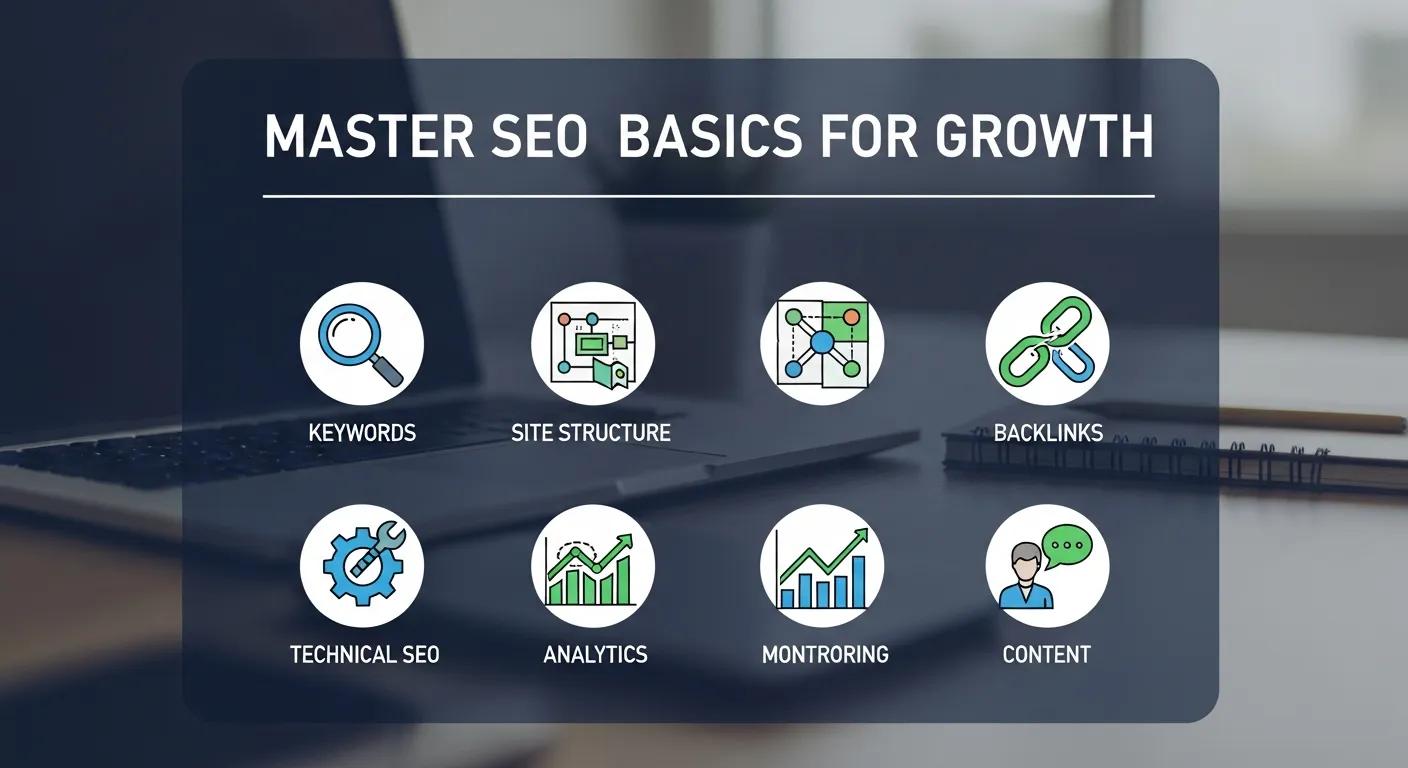
Master SEO Basics for Growth
Search engine optimization (SEO) is the practice of improving a website’s visibility in organic search results to attract targeted visitors and increase conversions. This guide shows how to build that foundation step by step. You will learn core SEO concepts—keyword research, on-page optimization, technical audits, link building, and performance measurement—plus practical actions you can take right away to improve rankings and organic traffic. Many beginners struggle to prioritize tasks and interpret search intent, which delays measurable improvements; this article solves that by mapping each foundational area to simple workflows and tools. The guide balances conceptual clarity with hands-on steps so you can move from strategy to implementation without guessing which metrics or fixes matter most. We cover what SEO is and why it matters, how to conduct keyword research with beginner-friendly tools, on-page techniques to optimize content, a technical SEO checklist for auditing and fixing issues, ethical link-building strategies, and the essential metrics and improvement loop to scale results. Read each section in order—concept, tools, action, measurement—to build a repeatable SEO process that grows organic traffic over time.
What is SEO and Why is it Essential for Your Website?
Search engine optimization (SEO) is the process of aligning a website’s content, technical setup, and external signals with how search engines discover and rank pages, thereby increasing organic visibility and valuable traffic. At its core, SEO improves relevance signals—keywords in content and metadata—and technical signals, such as crawlability and structured data, so that search engines can index and surface pages for relevant queries. The primary benefits are increased organic traffic, improved credibility through high visibility, and long-term high-visibilityROI compared with short-term ads. SEO also complements other digital marketing disciplines by feeding qualified leads into conversion funnels and, over time, reducing dependence on channels. Understanding these fundamentals sets up the following discussion on the three pillars of SEO: on-page, technical, and off-page, which together determine how well a site performs in organic search.
Understanding Search Engine Optimization Basics
SEO is built from three interacting pillars: on-page (content and HTML elements), technical (crawlability and performance), and off-page (backlinks and reputation). On-page SEO ensures content matches user intent through keywords, headers, and structured markup, while technical SEO makes that content discoverable by improving site speed, mobile-first readiness, and indexation. Off-page SEO establishes authority through high-quality backlinks and mentions that search engines use as credibility signals. These pillars operate together—strong content without crawlable pages limits impact, and fast, crawlable sites without relevant content won’t rank for queries—so coordinated work across all three yields the best outcomes and informs where to prioritize fixes.
How to Conduct Effective Keyword Research Using Top Tools?

Keyword research finds the search terms your audience uses and maps them to intent, volume, and opportunity so you can prioritize content that drives traffic and conversions. The process starts with seed ideas, expands to related queries using tools, segments by intent (informational, navigational, commercial, transactional), and filters and expands by keyword difficulty and business relevance to create a prioritized content plan. Effective research reveals long-tail opportunities with lower competition and higher conversion potential, and it informs on-page optimization, internal linking, and content clusters. Below is a step-by-step guide to a repeatable keyword research workflow for beginners, followed by a tool comparison and example mapping to illustrate the approach.
This numbered list explains a practical keyword research process beginners can follow.
- Identify 8–12 seed topics based on your core services or audience needs and write them down as starting points.
- Expand each seed term using keyword tools to collect related queries, questions, and long-tail phrases that match searcher intent.
- Segment expanded keywords by intent—informational, navigational, commercial, transactional—and prioritize those aligned with business goals.
- Filter candidates by search volume, difficulty, and opportunity cost; select a mix of quick-win long-tail keywords and strategic head terms.
This workflow creates a prioritized keyword list you can map to content types, and the next section compares beginner-friendly tools to perform these steps.
Introductory table comparing keyword research tools for beginners and their best use-cases.
This comparison helps beginners choose the right tool based on budget and the research stage, from idea generation to opportunity filtering. The following subsection breaks down which specific tools to consider and how to interpret their metrics.
Best Keyword Research Tools for Beginners
Several accessible tools provide the essential data beginners need: search volume, competition, and related queries that reveal intent and opportunity. Free tools are helpful for seed generation and question discovery, while paid suites add competitive analysis and keyword difficulty scores that help prioritize effort. Google Search Console gives real query data specific to your site and is indispensable for identifying pages that can be optimized for higher impressions and clicks. Choose tools based on your budget and needs: start with free options for ideation, then invest in a suite when you need scalable keyword lists and difficulty metrics.
This compact EAV table summarizes the practical strengths of common tool types and recommended use cases.
These tool categories let you match research tasks to the right resource and move from broad ideation to prioritized keyword targets. Next, we show how keyword research maps seed terms into target search phrases.
How Keyword Research Identifies Target Search Terms
Keyword research converts broad topics into specific, prioritized search terms by expanding seeds, grouping by intent, and scoring opportunities based on volume and difficulty. For example, a seed topic like “organic traffic strategies” can yield informational queries (“what is organic traffic?”), commercial queries (“SEO services for small business”), and transactional queries (“hire SEO consultant cost”). Evaluating intent ensures content answers the user’s need—tutorials for informational purposes and product pages for transactional intent—while long-tail phrases often present low-competition opportunities that convert better. By mapping each keyword to a content type and measuring expected effort against potential returns, you create a content roadmap that effectively drives both traffic and conversions.
This mapping approach naturally leads to on-page techniques that convert keyword opportunities into ranking improvements.
Which on-page SEO techniques are best for optimizing your content?
On-page SEO aligns each page with a target query through optimized titles, headers, content structure, and semantic markup to improve relevance and click-through rates. The mechanism works by signaling to search engines which queries best match the page, increasing the chance of ranking and triggering rich results when structured data is present. Practical on-page tactics include crafting title tags with primary keywords and modifiers, using descriptive H1/H2 hierarchies for scannability, and applying schema where appropriate to enhance SERP presentation. Implementing these techniques steadily improves relevance, user engagement, and the visibility of content clusters across related queries.
Step-by-Step Guide to On-Page SEO Best Practices
Apply a prioritized checklist to a single page to generate measurable uplift: identify intent, pick a primary keyword, optimize meta tags, structure headings, and add internal links to related pages. Use clear, descriptive title tags that combine your target keyword with an intent modifier, and write meta descriptions that improve click-through rates by summarizing the user benefit. Structure content with H2/H3 headings and short paragraphs for readability, and include images with descriptive alt text to support semantics and accessibility. Could you finish by adding internal links to topic cluster pages to distribute authority and help search engines understand your site’s information architecture?
This checklist prepares you to measure the impact of on-page changes and iterate, thereby shaping how on-page SEO influences ranking signals.
- Identify search intent: Match the page’s purpose to user queries.
- Optimize title and meta description: Use the target keyword and a value proposition.
- Structure content with headings: Improve scannability and semantic clarity.
- Use internal links and schema: Reinforce topical relationships and enable rich results.
Following these steps sets up measurable improvements in relevance and user engagement. The following subsection explains how these changes translate into ranking gains.
How On-Page SEO Improves Website Ranking
On-page SEO improves ranking by increasing relevance signals, enhancing click-through rate (CTR) in the SERPs, and improving dwell time through readable, well-structured content. Search algorithms interpret keyword placement in titles, headings, and body copy as signals about topical relevance. In contrast, behavioral signals like CTR and time on page can indirectly influence rankings by indicating user satisfaction. Optimized content that aligns with intent typically achieves higher engagement and creates more internal linking opportunities, amplifying a site’s topical authority. Measuring CTR, bounce rate, and conversions after on-page updates helps validate improvements and informs further optimization.
Understanding on-page mechanics primes you to address deeper technical constraints that may block indexing or performance gains, which we explore next.
Which Technical SEO Checklist Should Beginners Follow?

Technical SEO ensures search engines can crawl, render, and index your site efficiently while delivering a fast, mobile-first experience to users. It often provides high-impact wins when corrected. Key elements include crawlability and indexability, page speed and performance, mobile friendliness, secure connections (HTTPS), and structured data for enhanced search presentation. Auditing these elements with recommended tools exposes issues that prevent pages from being discovered or ranked, and prioritizing quick wins—like fixing robots.txt blocks and compressing images—generates measurable improvements. The following audit table maps technical elements to simple checks and expected fixes that beginners can perform.
Introductory table that maps technical elements to audit methods and typical remediation steps.
This table gives a practical audit plan that balances quick wins with deeper fixes to improve indexing and user experience. The following subsection explains how to check each element in more detail.
Key Technical SEO Elements to Audit Your Website
Auditing technical SEO requires checking crawl coverage, index status, redirects, canonicalization, page speed, mobile usability, and structured data validity using tools like Search Console, Performance Labs, and site crawlers. Start with a crawl to find blocked or orphaned pages, then review the index coverage report to confirm which pages are indexed or excluded and why. Run performance audits to identify render-blocking resources and large payloads that slow load times, and validate structured data for errors that prevent rich results. Prioritize fixes that unblock indexation and improve user experience, as these typically yield the most immediate ranking upside.
Fixing technical issues improves crawl efficiency and user experience, which directly feeds into broader organic optimization discussed next.
How Technical SEO Enhances Organic Search Optimization
Technical fixes increase the likelihood that your best content is discovered, indexed, and presented to users quickly, which raises organic impressions and the potential for higher rankings. Improving site speed reduces bounce rates and can improve rankings where performance is a differentiator, while mobile optimization ensures pages appear correctly for the majority of modern searches. Structured data enhances snippets and can increase CTR by providing richer information in SERPs, and clean crawl paths ensure search engines allocate crawl budget efficiently to your most important pages. Tracking indexing rates, Core Web Vitals, and mobile usability after remediation shows concrete improvements in discoverability and engagement.
Addressing technical constraints sets the stage for earning authority via backlinks, which we cover in the next section.
What Are Effective Link Building Strategies for SEO Success?
Link building establishes topical authority through external endorsements that search engines use as trust and relevance signals, and ethical, content-driven outreach produces sustainable results. White-hat tactics focus on creating valuable assets—original research, comprehensive guides, and useful tools—that others naturally reference, while targeted outreach amplifies distribution to relevant publishers and partners. Avoid manipulative practices; instead, pursue methods like resource link acquisition, broken-link reclamation, and collaborative content with domain-relevant partners. Measuring link value based on domain relevance, traffic, and follow status helps prioritize which links materially impact ranking.
Proven Link Building Techniques to Boost Authority
Several reliable techniques produce links with meaningful SEO value: creating linkable assets such as data-driven studies or tools, reclaiming unlinked brand mentions, and performing targeted outreach to resource pages or industry partners. For each tactic, please craft a concise value proposition explaining why the recipient’s audience benefits from linking to your content, and include a polite, personalized outreach message. Track outreach results and prioritize follow-ups with high-authority sites; even a small number of relevant links can shift rankings for competitive queries. Scaling these activities gradually while maintaining quality preserves domain reputation and sustains long-term gains in authority.
- Create data-driven content: Publish unique insights that others cite and link to.
- Reclaim mentions: Find and request links for pages that mention your brand without linking.
- Resource outreach: Suggest your content as an addition to relevant resource pages.
These tactics increase authority and referral traffic while avoiding risky shortcuts. Next, we explain how backlinks fit into the larger ranking signal ecosystem.
How Link Building Supports SEO Fundamentals
Backlinks function as endorsements: search engines interpret them as signals that content is valuable and relevant, especially when links come from authoritative, topically relevant domains. Quality outranks quantity; a single link from a highly relevant and trusted site often provides more ranking benefit than many low-quality links. Backlinks also drive referral traffic and can accelerate content discovery, especially when combined with internal linking strategies that pass authority to strategic pages. Measuring referring domain relevance, anchor diversity, and traffic impact helps you evaluate link-building ROI and refine outreach strategies over time.
Demonstrating authority via links positions you to measure and iterate on SEO performance, which the final section covers in practical detail.
How to Measure and Improve Your SEO Performance?

Measuring SEO performance focuses on tracking metrics that indicate visibility, engagement, and business outcomes, then running prioritized tests to improve them in a continuous loop. Essential metrics include organic traffic, search impressions, CTR, average ranking positions, conversions, and technical indicators like Core Web Vitals and crawl errors. Use the right tools to collect these metrics, map each metric to an actionable next step, and run experiments (A/B test titles, adjust internal links) to validate hypotheses. Below is a practical mapping of metrics to measurement tools, along with clear instructions on actions beginners can implement.
Introductory table that maps essential SEO metrics to tools and suggested next steps.
This mapping turns measurement into a prioritized action list that teams can use to iterate. The following subsection defines each metric and provides the location where it can be found.
Essential SEO Metrics and Tools for Beginners
Beginner-friendly metric tracking centers on a few high-impact measurements: organic sessions to monitor volume; impressions and CTR in search analytics to understand visibility and average rank; and conversions to tie results to business outcomes. Google Search Console exposes impressions, clicks, and CTR by query and page, while analytics platforms show session behavior and conversion funnels. Rank trackers and site crawlers complement these tools by monitoring position changes and technical issues. Set realistic KPIs—such as improving CTR by 10% or increasing content-driven conversions by 15%—and use data to prioritize tests that target the most significant gaps.
Measuring these metrics feeds directly into an iterative optimization cycle that turns data into continuous improvement.
Using Data to Continuously Improve Website Ranking
A simple three-step optimization loop keeps SEO work focused and measurable: measure baseline performance, hypothesize targeted changes, and implement experiments to test the impact, and repeat based on results. Examples of experiments include A/B testing title tags, reworking internal linking to surface priority pages, and refreshing content to target newly discovered long-tail queries. Prioritize tests by expected impact and implementation cost, and document outcomes to build an evidence base for future decisions. Over time, this disciplined, data-driven approach compounds improvements in visibility and conversions, and it supports strategic decisions about content investment and technical fixes.
This iterative process completes the beginner’s roadmap—from discovery and optimization to technical fixes and measurement—and encourages steady progress through clear, data-backed actions.
For targeted help building content hubs, structured data, or a prioritized SEO roadmap, consider that Launched, identified through its public business profile, focuses on digital marketing and technology solutions and recommends building SEO-focused content hubs and structured data to improve discoverability. Integrating content hubs with consistent schema markup can accelerate indexing and increase the chance of rich results, and partnering with a specialized provider can help implement these practices at scale while keeping your internal team focused on content creation and testing.

Erik Remmel is a co-founder of Launched, a platform that helps businesses grow through AI-powered marketing, automation, and lead generation. He focuses on building scalable systems that convert cold leads into customers while streamlining operations with smart, AI-driven workflows.