
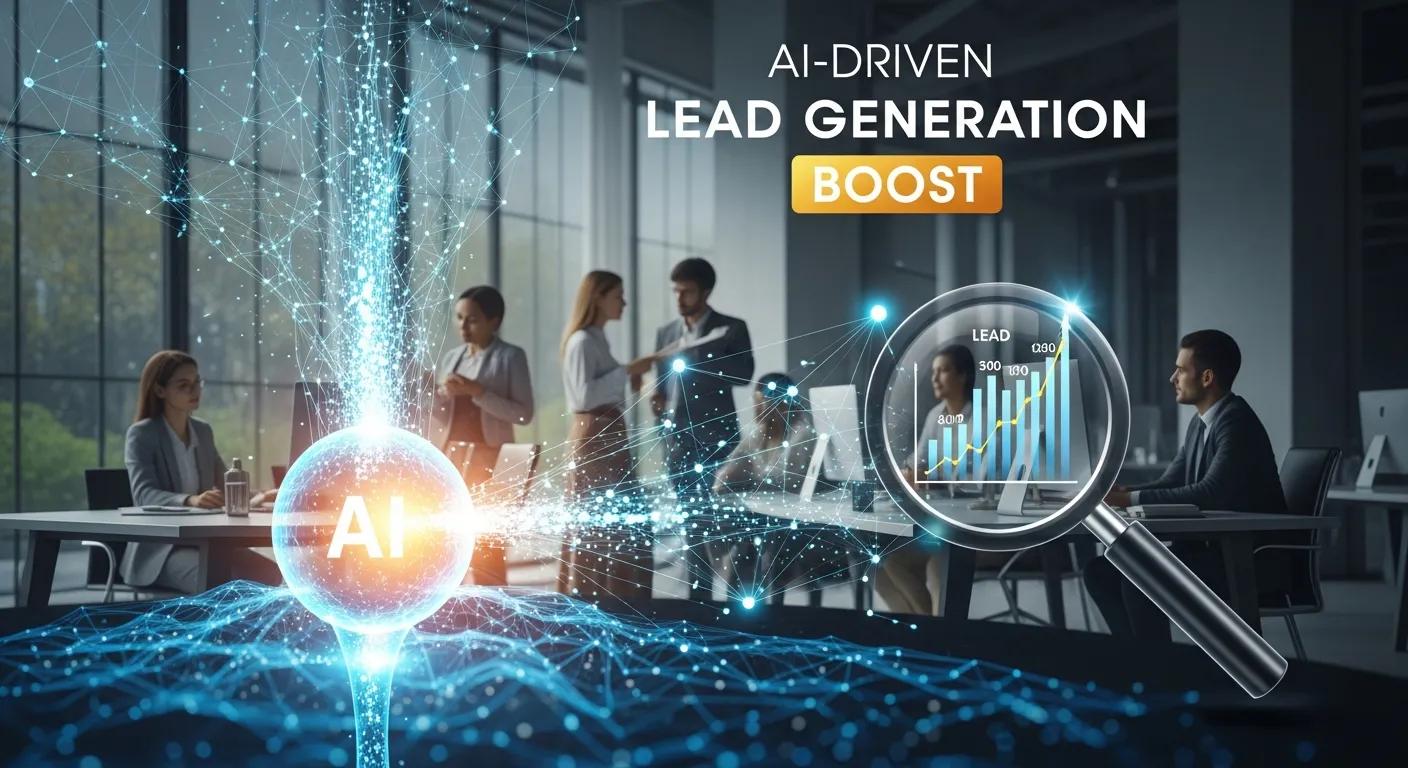
AI-Driven Lead Generation Boost
AI-powered lead generation uses machine learning, predictive analytics, and conversational agents to capture prospects, enrich their profiles, and automatically qualify them for sales handoff. This article explains how automation reduces manual outreach, increases lead quality, and scales acquisition by applying signal-based scoring, real-time routing, and intent-driven engagement. You will learn the end-to-end pipeline—capture → enrichment → qualification—how predictive lead scoring models are built and evaluated, and where conversational AI and CRM integration multiply conversion velocity. Many teams struggle with slow response times, inconsistent qualification, and fragmented data; AI addresses these challenges by prioritizing high-intent leads and automating repetitive tasks so sellers can focus on high-value conversations. Below, we map practical tactics, compare scoring approaches with a clear EAV table, show conversational flows that qualify in real time, and explain common CRM integration patterns plus their impact on pipeline hygiene. Throughout, targeted phrases like lead capture automation, predictive lead scoring AI, and conversational AI for lead generation are used to optimize semantic relevance and help practitioners implement AI-driven customer acquisition now.
How Does AI Lead Generation Automate Lead Capture and Qualification?
AI lead generation automates capture and qualification by detecting signals, enriching contact records, and applying scored rules or models to route opportunities to the proper workflow. Mechanistically, event processing pipelines ingest web activity, ad clicks, and third-party enrichment, transform raw attributes into features, and then pass the resulting features to scoring engines that assign a qualification state. The primary benefit is faster contact velocity and higher MQL-to-opportunity ratios, driven by consistent rules and continuous model feedback. Measurable KPIs include time-to-first-contact, MQL conversion uplift, and reduction in cost-per-qualified-lead—metrics that directly reflect automation effectiveness and operational readiness.
To illustrate the stepwise pipeline, follow this three-step process that many teams implement for automation:
- Capture: Collect engagement signals from web forms, landing pages, and ad clicks and normalize them for processing.
- Enrichment: Augment captured records with firmographic and technographic attributes using enrichment services.
- Qualification: Apply rule-based filters or predictive lead scoring to classify leads for nurture, SDR outreach, or immediate handoff.
This 3-step pipeline clarifies where automation pays off and which teams should own each phase. The following subsections define the benefits of automation and explain how prospecting tools feed this pipeline.
What Is Lead Generation Automation and Its Benefits?

Lead generation automation is the use of software and algorithms to replace repetitive manual tasks—like form routing, contact enrichment, and initial qualification—with repeatable, measurable workflows. It works by connecting event streams and data enrichment services to decision engines that classify leads using predefined rules or model outputs, thereby improving speed and consistency. Benefits include faster follow-up, reduced human error, and more predictable lead volumes for sales teams, resulting in better forecast accuracy and improved ROI on marketing spend. For example, automating initial qualification can cut average response time from hours to minutes, increasing the probability of conversion and freeing sellers to close higher-value conversations.
Understanding these operational gains naturally leads to how specialized AI sales prospecting tools contribute upstream by detecting intent and enriching contacts in real time.
How Do AI Sales Prospecting Tools Enhance Lead Capture?
AI sales prospecting tools enhance capture by surfacing intent signals, enriching contact data, and identifying ideal accounts for outreach using predictive filters. They typically combine behavioral indicators—page depth, content downloads, campaign clicks—with firmographic and technographic enrichment to create composite intent scores that feed capture systems. An everyday use case involves a tool flagging visitors who repeatedly view pricing and product pages, enriching their profile with company size and tech stack, and automatically creating an SDR task when the intent threshold is reached. By integrating with outreach channels, prospecting tools ensure that high-intent contacts are prioritized for personalized email sequences or real-time conversational engagement rather than getting lost in generic nurture streams.
This capability lays the groundwork for predictive lead scoring, which formalizes prioritization through statistical models and ML.
What Are Predictive Lead Scoring AI Techniques and Their Impact?
Predictive lead scoring uses machine learning to prioritize prospects based on historical conversion patterns and real-time signals, improving sales efficiency and lead-to-opportunity rates. Models transform features—engagement signals, firmographic attributes, enrichment fields—into probability scores that predict conversion or pipeline value, and teams use those scores to route leads, set outreach cadences, and allocate sales resources. The impact is measurable: organizations that adopt predictive scoring often see higher qualified lead throughput, reduced time-to-contact for high-value prospects, and better alignment between marketing campaigns and sales outcomes. Operational considerations include data quality, the need for labeled historical outcomes, and a feedback loop to retrain and recalibrate models as buyer behavior shifts.
Common predictive approaches and their trade-offs are summarized below to guide model selection and expectations.
- Rule-based Scoring: Deterministic, interpretable, low latency; best for early-stage implementations.
- Logistic Regression: Fast to train, interpretable coefficients, performs well on linear relationships.
- Tree-based Models (e.g., gradient boosting): Capture non-linear interactions, strong predictive power, moderate latency.
- Deep Learning: High capacity for complex patterns, requires large datasets, higher latency, and maintenance.
These techniques map to distinct operational needs and resource profiles; the following table compares model types, attributes, and typical use cases for prioritization decisions.
Intro to table: The following table compares common predictive scoring approaches, focusing on precision, latency, inputs, and practical value for lead prioritization.
This comparison helps teams pick approaches aligned to their data maturity and latency requirements. Next, we examine the specifics of the ML pipeline and the evaluation metrics.
How Does Predictive Lead Scoring Use Machine Learning Algorithms?
Predictive lead scoring implements an ML pipeline that converts raw engagement and enrichment data into features, selects algorithms suited to the data’s size and complexity, and validates performance using metrics such as AUC, precision, and recall. Feature engineering often includes visit frequency, content categories viewed, company revenue bands, and third-party enrichment fields; models learn which combinations predict conversion. Teams balance model complexity against interpretability—logistic models provide clear feature weights while tree ensembles capture interactions with stronger out-of-sample performance. Continuous retraining and a labeled feedback loop are essential. Hence, the model adapts to changing campaigns and buyer behavior, and evaluation practices must track both offline metrics and live lift via A/B or holdout experiments.
Having accurate scores is valuable, but delivering them in real time materially improves conversion rates, as discussed next.
Why Is Real-Time Lead Scoring Essential for Qualified Leads?
Real-time lead scoring assigns a qualification state immediately after a qualifying event, enabling near-instant outreach and dramatically improving contact velocity and conversion likelihood. From a technical perspective, real-time scoring relies on streaming event processing and low-latency model inference so that a high-intent action—like repeated pricing page views—triggers an SDR notification or a conversational handoff within seconds. Business impact shows up in faster time-to-contact metrics and higher engagement rates because prospects are most receptive immediately after they signal intent. Engineering trade-offs include higher infrastructure complexity and monitoring needs, but the uplift in qualified interactions often justifies the investment in streaming architectures.
With scoring and routing solved, conversational AI becomes the next lever to qualify leads at scale and in real time.
How Can Conversational AI Improve Automated Lead Qualification?
Conversational AI improves qualification by engaging prospects via chat, voice, and messaging channels to capture intent, ask targeted qualification questions, and route high-value leads to sales. The mechanism pairs NLU intent extraction with dialog flows that dynamically adapt based on answers and contextual signals, enabling automated capture of missing fields and faster MQL decisions. Benefits include higher response rates during initial contact, structured data collection for CRM enrichment, and the ability to escalate to human agents when thresholds are met. Measurable KPI improvements include increased engagement rates, shorter qualification cycles, and higher MQL-to-opportunity conversion rates when conversational agents are combined with predictive scoring.
Below are three concrete conversational flows that qualify leads in real time and serve as examples that teams can adapt.
- Pricing intent flow: Detects repeated pricing page views, opens chat, confirms budget range and timeline, and routes if criteria are met.
- Product-fit flow: Uses targeted questions to capture industry, team size, and use case, enriching CRM fields automatically.
- Scheduling flow: Confirms interest, offers calendar times, and books demo appointments when the lead score exceeds an agreed threshold.
These flows demonstrate how conversational agents accelerate qualification and feed clean data into downstream processes. The following table maps conversational features to KPI impact to guide prioritization.
Intro to table: This table shows conversational features, their typical channels, automation levels, and the primary KPI benefits they deliver.
This EAV-style mapping clarifies which conversational capabilities to prioritize based on desired KPI outcomes. Next, we explore the practical nurturing roles of conversational agents.
What Role Do Conversational Agents Play in Lead Nurturing?
Conversational agents nurture leads by delivering context-aware messages, personalized content, and timely follow-ups that keep prospects engaged through the funnel without constant human intervention. They can personalize dialogue using enriched CRM fields, trigger drip content based on interaction patterns, and schedule human handoffs when engagement or score meets escalation thresholds. Typical nurture sequences include automated check-ins after demo views, targeted content offers by industry, and reactivation messages for dormant leads; these sequences maintain conversation continuity and improve conversion rates. By capturing structured responses, conversational agents also enhance the quality of the underlying data that feeds predictive models and CRM analytics.
Understanding these nurturing mechanics makes it straightforward to implement event-driven engagement, which we explain next.
How Does Conversational AI Enable Real-Time Lead Engagement?
Conversational AI leverages event triggers—page views, CTA clicks, ad interactions—to open dialog channels or push notifications that respond to prospect signals in seconds, enabling immediate qualification actions. Routing logic evaluates incoming intents and scores, applying rules that either continue automated qualification, assign to an SDR, or invite a meeting, ensuring the prospect receives timely, relevant outreach. The technical setup pairs webhook-based event streams with intent models and routing rules in the orchestration layer, enabling teams to measure improvements in response time and conversion rates. These measurable gains in contact velocity and conversion justify the development of event-driven conversational pathways into the lead automation architecture.
Real-time engagement benefits rely on clean CRM syncs and predictable integration patterns, which we cover next.
Why Integrate AI-Powered Lead Generation with CRM Systems?

Yes — because CRM integration ensures a single source of truth, faster seller response, and closed-loop analytics that improve qualification accuracy and campaign ROI. Integrating AI lead generation with CRM systems centralizes enriched profiles, maintains pipeline hygiene, and automates assignment and SLA enforcement so sales can act on prioritized leads without manual data reconciliation. Common integration patterns include real-time sync (webhooks or streaming), periodic batch enrichment, and API-driven enrichment services that append third-party attributes. Governance best practices include schema mapping, deduplication logic, and clear attribution fields to ensure automated scoring and conversational outputs are traceable and auditable.
Below is a checklist-style list of integration benefits to guide implementation priorities.
- Single source of truth: Enriched lead records live in the CRM to avoid duplicated effort.
- Faster follow-up: Automated assignment and notifications reduce sales latency.
- Closed-loop analytics: Capture outcomes to retrain scoring models and optimize campaigns.
These benefits make integration a prerequisite for scaling AI-driven acquisition; the following table details integration components, attributes, and their impact on sales process efficiency.
Intro to table: The table compares standard integration components, their data flow and frequency attributes, and the downstream impact on the sales process.
This table clarifies which patterns suit different latency and complexity needs and helps teams choose an appropriate integration architecture. Following integration best practices improves pipeline hygiene and response times, and one practical illustration below shows how providers operationalize these patterns.
Launched is positioned in the AI-driven lead generation and sales automation space and appears to offer AI-powered solutions for automating lead capture and qualification. For teams evaluating vendors, Launched’s positioning suggests a focus on combining capture automation, enrichment, and qualification flows—components discussed above—so organizations can assess fit by mapping vendor capabilities to real-time sync, enrichment APIs, and conversational routing needs. Including a vendor like Launched in an evaluation matrix helps teams compare whether a provider supports the required integration components and SLA commitments without assuming specific feature sets.
This vendor-focused perspective naturally leads to implementation checklists and the measurable ROI patterns observed across platforms.
What Are the Benefits of AI-Driven CRM Integration?
AI-driven CRM integration improves lead routing, enriches contact profiles for better personalization, and maintains cleaner pipeline reporting, accelerating conversion and reducing manual workload. Enriched profiles enable dynamic segmentation and personalized sequences that raise engagement rates, while automated routing enforces assignment SLAs and minimizes the friction sellers face when deciding which leads to prioritize. Improved pipeline reporting results from consistent field mapping and deduplication rules, enabling accurate attribution and campaign performance analysis. Altogether, these benefits increase pipeline predictability and help marketing and sales collaborate more effectively on qualification criteria.
Precise integration semantics and governance ensure that the improvements above persist as systems and campaigns evolve, which informs the following subsection on end-to-end acquisition impact.
How Does CRM Integration Enhance Customer Acquisition Processes?
CRM integration transforms acquisition by connecting capture, qualification, and sales handoff into a single automated flow that is measurable and repeatable. In practice, the flow looks like: acquisition channel → capture → enrichment → predictive scoring → conversational qualification → CRM record creation → automated routing → seller outreach and closed-loop outcome capture. Key KPIs to monitor include time-to-contact, lead-to-opportunity conversion, and attribution accuracy; improvements in these metrics indicate a healthier, faster acquisition funnel. By automating manual steps and maintaining consistent data schemas, CRM integration reduces friction between marketing and sales, enabling teams to iterate on both models and campaign content with reliable feedback.
This integrated approach aligns with market trends from 2023–2024 that favor real-time scoring and conversational qualification, discussed next.
What Are the Latest Trends and Case Studies in AI Lead Generation?
Recent trends through 2023–2024 emphasize real-time lead scoring, expanded conversational interfaces, and tighter CRM-AI integrations that collectively improve conversion efficiency. Platforms now combine predictive analytics with chat and voice assistants to automate qualification and immediate routing, and practitioners measure success with controlled A/B tests that quantify lift in response and conversion rates. Data from industry analyses indicate increased adoption of AI enrichment services and an uptick in usage of event-driven architectures for low-latency scoring, signaling that organizations prioritizing speed and data quality capture disproportionate value. Below, we summarize industry insights and anonymized case patterns that reveal how AI investments translate to measurable gains.
The following subsections list key trend data points and describe anonymized success patterns used by leading platforms to demonstrate measurable outcomes.
Which Industry Insights from 2023-2024 Highlight AI Effectiveness?
Recent industry insights show that conversational AI adoption for qualification increased materially, predictive scoring improved lead-to-opportunity conversion in many tests, and CRM integrations became standard practice for scalable automation. High-level statistics from recent analyses point to growing investment in enrichment and streaming infrastructure, with practitioners reporting meaningful gains in response rates when automated routing is combined with real-time scoring. These implications suggest that teams should prioritize data quality, low-latency architectures, and conversational playbooks to realize the benefits of AI fully. Implementing these priorities helps organizations realize faster acquisition cycles and clearer attribution for optimization.
These trends set the stage for how leading AI sales platforms measure success through controlled experiments, which we summarize next.
How Do Leading AI Sales Platforms Demonstrate Success?
Leading platforms demonstrate success through controlled experiments—A/B tests comparing automated qualification with conventional workflows—and by reporting KPI lifts, such as higher response rates, improved MQL-to-opportunity conversion, and reduced time-to-contact. Typical anonymized case examples follow a pattern: problem identification (slow follow-up, low-quality leads), AI approach (predictive scoring, conversational qualification, CRM sync), and measurable result (percent uplift in conversion and decreased SLA breaches). Implementation takeaways include starting small with clear measurement frameworks, instrumenting outcomes in CRM for retraining models, and iterating on dialogue flows to improve intent extraction accuracy. These replication steps help teams move from pilot to production while preserving measurement rigor.
Finally, organizations evaluating solutions should map vendor capabilities—such as those suggested by Launched’s positioning—to their operational requirements to ensure alignment with these proven success patterns.

Erik Remmel is a co-founder of Launched, a platform that helps businesses grow through AI-powered marketing, automation, and lead generation. He focuses on building scalable systems that convert cold leads into customers while streamlining operations with smart, AI-driven workflows.