
Boost Sales Efficiency with Launched AI Automation Tools
AI sales automation uses artificial intelligence to automate, optimize, and personalize sales tasks across the funnel, accelerating lead qualification, outreach, and forecasting while preserving human oversight. This guide explains how AI for sales process automation combines machine learning, natural language processing, and predictive analytics to reduce manual work and increase conversion velocity for revenue teams. Readers will learn what AI sales automation is, how it differs from traditional automation, the technologies that power it, the measurable business benefits, concrete use cases, an implementation roadmap, and the trends shaping 2025 and beyond. Many sales leaders face overloaded pipelines, slow follow-ups, and noisy CRM data; AI sales automation addresses these pain points by automating repetitive tasks, surfacing high-value prospects, and enabling personalized engagement at scale. The article is structured into five sections that walk from definition and benefits to practical implementation and future trends, with actionable lists, comparison tables, and pilot-ready checklists optimized for decision-makers and practitioners. Throughout, targeted keywords such as sales automation software, conversational AI for sales, lead scoring AI, and predictive RevOps are used to connect strategic concepts with operational steps.
What is AI Sales Automation and How Does It Transform Sales Processes?
AI sales automation uses AI technologies to automate sales workflows, predict outcomes, and personalize customer interactions, enabling teams to close deals faster and with less manual effort. It works by ingesting CRM and interaction data, using machine learning to detect patterns, applying NLP to interpret customer intent, and triggering automated actions that move prospects through the funnel. The result is improved pipeline velocity, higher contact rates, and data-driven prioritization that focuses seller time on the highest-value opportunities. Understanding these mechanics clarifies why AI sales automation shifts organizations from reactive task handling to proactive, predictive selling that adapts over time.
Further research confirms the significant role of AI and machine learning in enhancing the efficiency and optimization of sales processes.
AI & ML for Sales Process Optimization & Efficiency This study explores the literature on how artificial intelligence (AI) and machine learning (ML) can optimizeby integrating sales processes, using a scientometric and bibliometric approach. The results reveal that the adoption of AI and ML technologies is highly correlated with improved sales process efficiency, highlighting their growing importance in developing business strategies. Optimizing sales processes with artificial intelligence and machine learning: A scientometric analysis, 2024
AI & ML for Sales Process Optimization & Efficiency
This study explores the literature on how artificial intelligence (AI) and machine learning (ML) can optimizeby integrating sales processes, using a scientometric and bibliometric approach. The results reveal that the adoption of AI and ML technologies is highly correlated with improved sales process efficiency, highlighting their growing importance in developing business strategies.
Optimizing sales processes with artificial intelligence and machine learning: A scientometric analysis, 2024
AI sales automation transforms distinct sales stages by replacing rote human tasks—such as manual prospect tagging, template-based follow-ups, and static reports—with adaptive models that learn and improve. This transformation is visible in earlier qualification, faster lead routing, dynamic outreach cadence, and continuously refined forecasts. The following subsection compares this adaptive model with traditional rule-based automation to highlight practical differences and expected gains.
How Does AI Sales Automation Differ from Traditional Sales Automation?
AI-driven sales automation differs from traditional automation primarily through adaptivity, prediction, and personalization rather than fixed rules and scheduled tasks. Where rule-based systems follow predefined triggers and static templates, AI systems analyze ongoing data to predict which leads are most likely to convert and tailor outreach in real time, improving relevance and response rates. This learning capability reduces manual tuning and often improves outcomes as models incorporate new signals from interactions and external data. The comparison shows why organizations seeking sustained pipeline improvement favor AI for sales efficiency and longer-term forecasting accuracy.
Traditional automation excels at deterministic, repeatable tasks such as bulk emailing or scheduled reminders, but it lacks continuous learning and predictive prioritization. Teams, therefore, often blend both approaches—using rule-based tools for operational consistency and AI components for scoring, personalization, and forecasting—so sales processes become both reliable and intelligent. This hybrid pattern informs choices about technology architecture and integration strategies discussed next.
Which Core Technologies Power AI Sales Automation?
AI sales automation rests on a small set of core technologies: machine learning for pattern detection and scoring, natural language processing for conversational interfaces, predictive analytics for forecasting, and integrations/APIs for CRM and data connectivity. Machine learning models surface propensity scores and segment leads, while NLP enables conversational AI assistants to qualify leads and capture intent via chat or voice. Predictive analytics combine historical pipeline data and real-time signals to produce more accurate forecasts and to prioritize opportunities. Robust API and CRM connectors ensure models have clean, timely inputs and that automated actions are enacted where reps work, creating a closed loop between intelligence and execution.
Specifically, studies highlight that advanced AI techniques such as Natural Language Processing and Reinforcement Learning are crucial for optimizing sales automation workflows and personalizing customer engagement.
AI for Sales Automation: NLP & RL for Workflow Optimization This research paper explores the optimization of sales automation workflows through the integration of Artificial Intelligence, focusing specifically on Natural Language Processing (NLP) and Reinforcement Learning (RL) algorithms. The study begins by identifying the inherent challenges in traditional sales processes, such as inefficiencies in lead qualification and customer engagement, which often impede revenue growth. By leveraging NLP, the paper demonstrates how AI can enhance the comprehension of customer intent through analysis of textual data, thus enabling more personalized and timely interactions. The research further employs RL algorithms to adaptively refine sales strategies based on dynamic customer behavior and market conditions, allowing real-time decision-making that maximizes conversion rates. Optimizing Sales Automation Workflows with AI: Leveraging Natural Language Processing and Reinforcement Learning Algorithms, 2023
AI for Sales Automation: NLP & RL for Workflow Optimization
This research paper explores the optimization of sales automation workflows through the integration of Artificial Intelligence, focusing specifically on Natural Language Processing (NLP) and Reinforcement Learning (RL) algorithms. The study begins by identifying the inherent challenges in traditional sales processes, such as inefficiencies in lead qualification and customer engagement, which often impede revenue growth. By leveraging NLP, the paper demonstrates how AI can enhance the comprehension of customer intent through analysis of textual data, thus enabling more personalized and timely interactions. The research further employs RL algorithms to adaptively refine sales strategies based on dynamic customer behavior and market conditions, allowing real-time decision-making that maximizes conversion rates.
Optimizing Sales Automation Workflows with AI: Leveraging Natural Language Processing and Reinforcement Learning Algorithms, 2023
These technologies work together: ML produces scores, NLP gathers and interprets customer inputs, predictive analytics translates signals into forecasts, and integrations push insights back into workflows. Understanding how each component contributes helps teams select vendors, define data needs, and measure the impact of AI sales automation across downstream KPIs and process redesign.
What Are the Key Benefits of AI Sales Automation for Businesses?
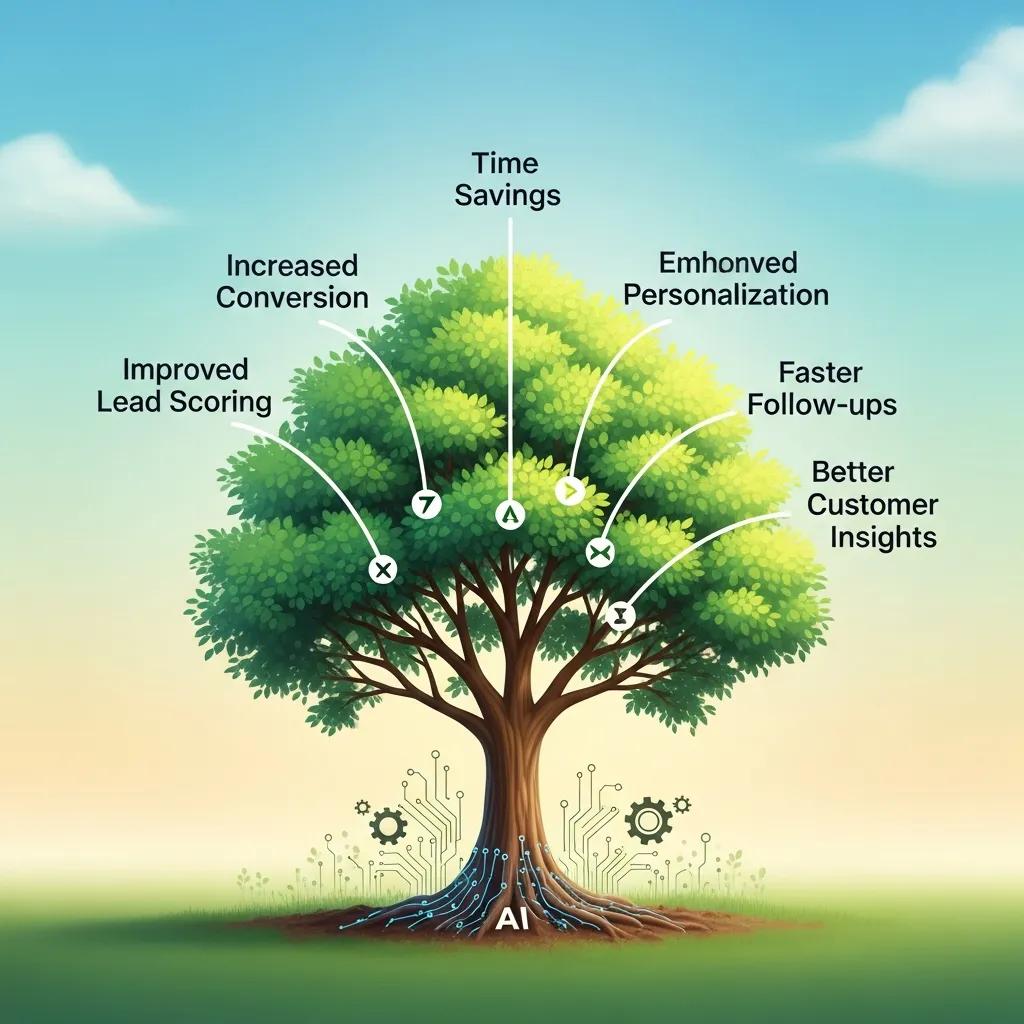
AI sales automation delivers measurable benefits across conversion, efficiency, personalization, forecasting, and cost management by applying intelligent automation to the sales lifecycle. By automating qualification and follow-ups, teams increase lead conversion rates while reducing time spent on low-value tasks. Personalization at scale raises engagement, and predictive forecasts improve resource allocation and pipeline hygiene. The following list summarizes the most important benefits and how they translate into business outcomes.
AI sales automation provides these primary advantages:
- Increased Lead Conversion: Predictive scoring focuses outreach on high-propensity prospects, improving close rates.
- Time Savings for Sales Teams: Automating administrative tasks frees reps for revenue-generating activities.
- Enhanced Personalization: Dynamic messages and contextual responses increase reply and meeting rates.
- Improved Forecasting and Pipeline Visibility: Data-driven models reduce forecasting errors and enable more effective capacity planning.
- Cost Reduction and Scale: Automated engagement reduces service costs and scales simultaneous interactions without linear headcount growth.
These benefits are enabled by specific AI mechanisms and can be mapped to KPIs for planning and measurement.
Intro to the benefits table: The table below maps each high-level benefit to the AI mechanism that delivers it and to the typical KPIs organizations track when measuring success. Use this mapping to create clear ROI hypotheses before piloting AI sales automation.
This table clarifies how specific AI features translate to the metrics that finance and RevOps care about, helping sponsors select initial KPIs. The following section explores how those mechanisms apply to lead generation, qualification, and personalized engagement.
How Does AI Enhance Lead Generation and Qualification?
AI enhances lead generation by scoring incoming leads against propensity models, enriching records with third-party and behavioral data, and using conversational AI to qualify intent in real time. A typical workflow captures a web or inbound lead, enriches the profile, applies a lead score, and routes high-score prospects to sellers while diverting lower-priority contacts to automated nurturing. This reduces manual prospect triage and increases the share of qualified leads passed to sales. Teams tracking the impact should monitor metrics such as lead-to-opportunity conversion rate, time-to-contact, and the percentage of marketing-qualified leads accepted by sales.
The enrichment and scoring steps rely on consistent data inputs and periodic model retraining to maintain accuracy. Continuous feedback loops—where closed-won outcomes update models—improve scoring over time and reduce false positives, which further tighten qualification precision and shorten sales cycles.
In What Ways Does AI Personalize Customer Engagement and Increase Sales Efficiency?
AI personalizes engagement through contextual message generation, adaptive cadence engines, and NLP-based conversational experiences that tailor responses to intent and disposition. Generative templates and dynamic content adjust messaging based on account history, persona, and recent interactions to increase relevance and drive higher response rates. Automation of timely follow-ups ensures no opportunity cools due to missed touches, and coordinated multichannel sequences raise contact rates without burdening reps. These mechanisms increase seller efficiency by focusing human effort where it matters most—complex negotiation and relationship building—while automating repetitive outreach and data capture.
Personalization at scale requires clean data and configurable templates connected to scoring and orchestration engines, which ensure messages remain consistent and compliant while still being individualized. Measuring the uplift from personalization involves tracking reply rate, meeting-set rate, and subsequent conversion into pipeline stages.
Boost Sales Efficiency with Launched AI Automation Tools
AI delivers value across distinct use cases in the sales funnel, where intelligence replaces routine tasks and amplifies the work of human sellers. High-impact applications include lead scoring and prioritization, automated outreach and follow-ups, conversation intelligence for coaching, CRM data enrichment, and sales forecasting for resource planning. Focusing pilots on one or two of these use cases produces clearer ROI and more manageable integration scopes. Below is a comparison table that links everyday use cases to the AI components that enable them and the typical business outcomes organizations observe.
This comparison helps teams prioritize pilots that align with their existing operational bottlenecks and measurable goals. After outlining where AI helps most, consider how conversational AI specifically improves engagement and support.
After mapping use cases to outcomes, it’s helpful to see real vendor approaches in the market. One example of a provider focused on these areas is Launched, a platform described as AI-powered marketing, automation, and lead generation, co-founded by Erik Remmel. Launched offers conversational AI and an AI-powered sales automation platform that assists with lead qualification, customer engagement, and sales process optimization. Its stated strengths include 24/7 customer engagement, improved lead conversion, streamlined sales processes, personalized interactions via NLP, and scalability for simultaneous interactions. This vendor example illustrates how a conversational AI solution maps directly to the use cases above—especially automated outreach, lead qualification, and scalable engagement—while remaining illustrative rather than prescriptive.
How Does Conversational AI Improve Customer Engagement and Support?
Conversational AI—chatbots or voice assistants powered by NLP—improves engagement by providing instant responses, qualifying leads continuously, and transferring complex conversations to humans when needed. These systems can handle simple qualification questions, book appointments, answer common queries, and capture lead attributes into the CRM, enabling 24/7 responsiveness that reduces friction for prospects. Conversational AI also shortens time-to-contact and reduces the manual burden on sales and support teams, thereby lowering costs and increasing throughput. For best results, teams implement escalation rules and handoff signals so that high-value or nuanced opportunities are routed to human reps seamlessly.
Monitoring performance involves tracking automated-to-human handoff rates, qualification accuracy, and conversion rates after handoff, which together indicate whether conversational flows correctly capture and route intent. Regular script refinement and model evaluation ensure the system maintains high-quality interactions and integrates cleanly with follow-up sequences.
Which AI Tools Optimize Lead Scoring, Sales Forecasting, and Automated Follow-ups?
When evaluating tool categories, teams should consider lead scoring engines, conversation intelligence platforms, outreach automation/orchestration systems, and CRM-native AI modules as the core vendor categories to assess. Key evaluation criteria include integration capabilities with existing CRM, model explainability, data requirements and governance, and the ability to customize scoring logic and sequencing. A practical RevOps feature checklist includes real-time scoring, bi-directional CRM sync, multichannel orchestration, privacy controls, and reporting dashboards. Choosing the right mix depends on whether the priority is immediate outreach automation, improved forecasting, or deeper conversation analytics.
To select tools, create a shortlist, run lightweight pilots focused on one measurable use case, and compare outcomes across conversion lift, time saved per rep, and forecast accuracy. This approach keeps vendor selection data-driven and aligned to quantifiable business impact.
How Can Businesses Implement AI Sales Automation Successfully?
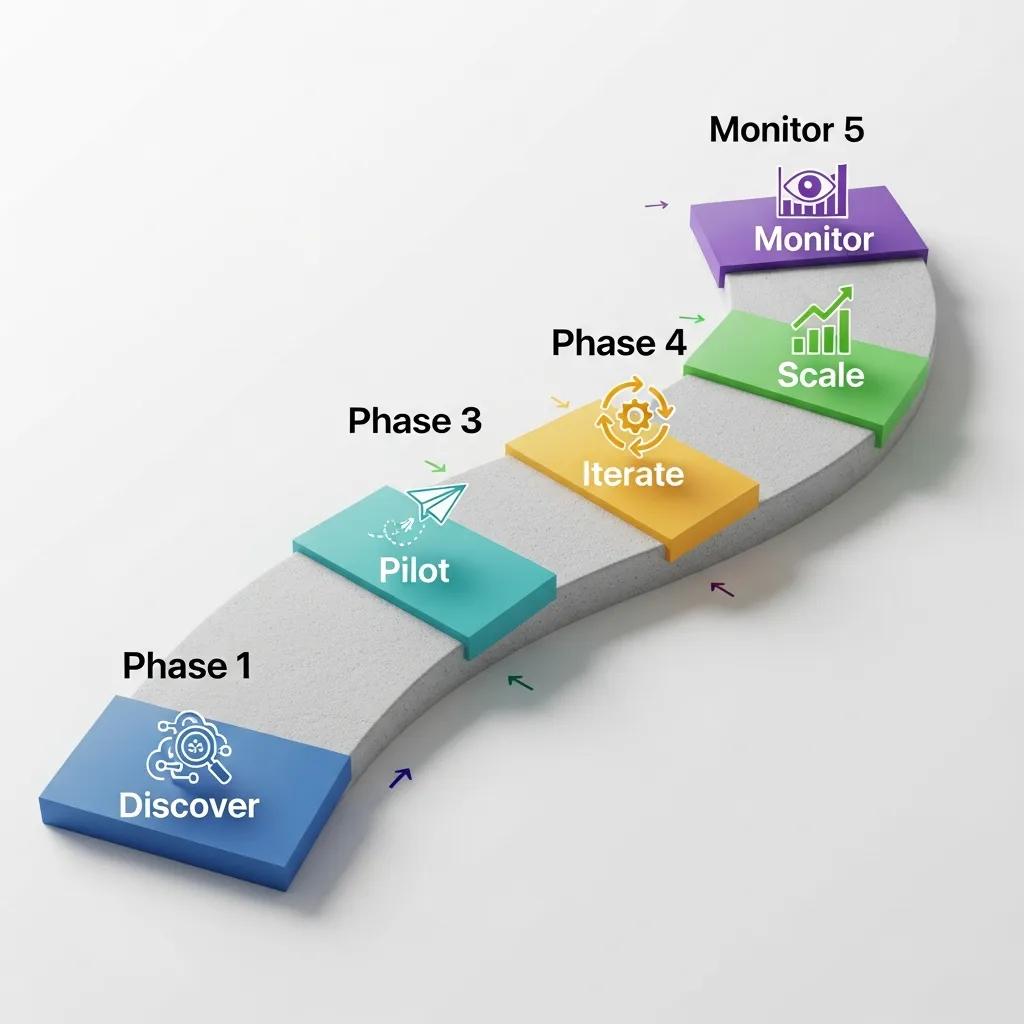
Successful implementation of AI sales automation follows a phased governance, pilot design, and adoption approach that reduces risk and maximizes measurable gains. Begin by assessing data readiness and business priorities, design a focused pilot with clear KPIs, and iterate quickly while establishing change management and monitoring. Governance over data, model transparency, and escalation paths ensures trust in automated decisions and better adoption by sales teams. The stepwise approach below provides an actionable path from Discovery to scale.
Understanding the broader impact and strategic approaches to overcoming implementation challenges is key to successful AI adoption in enterprise sales.
AI Sales Automation: Impact & Implementation Strategies AI in sales automation, its impact on enterprise software development, and strategies to overcome implementation challenges AI-Driven Sales Automation and Its Impact on Enterprise Software Development
AI Sales Automation: Impact & Implementation Strategies
AI in sales automation, its impact on enterprise software development, and strategies to overcome implementation challenges
AI-Driven Sales Automation and Its Impact on Enterprise Software Development
Intro to the implementation checklist: The numbered checklist below outlines the essential phases most organizations follow when adopting AI sales automation, with focused actions that map to measurable success metrics.
- Discover: Map processes, identify bottlenecks, and audit data quality to pick a high-impact use case.
- Pilot: Define scope, KPIs, timeframe, and success criteria; deploy on a representative segment.
- Iterate: Use pilot feedback to refine models, conversational flows, and CRM mappings.
- Scale: Expand to additional segments and integrate deeply with the revenue stack once KPIs are met.
- Monitor: Implement dashboards and retrain models regularly to maintain accuracy and alignment.
This phased plan emphasizes measurable checkpoints and continuous feedback loops so AI investments produce sustained improvements rather than temporary gains.
Intro to the implementation table: The table below converts the phases into concrete action items and the success metrics leadership should track to validate progression from Pilot to scale.
This table helps teams structure governance and ensure every expansion step has clear criteria. The following subsection provides a HowTo-style ordered list for phase execution.
What Are the Step-by-Step Phases to Adopt AI Sales Automation?
Adopting AI sales automation requires disciplined sequencing from Discovery through monitoring, with clear owner responsibilities and measurable outcomes for each phase. In Discovery, identify a pilot cohort, catalogue systems and data sources, and establish a baseline. During Pilot, configure integrations, set up scoring models, and run the automation on a limited segment while collecting qualitative feedback from sellers. In Iterate, analyze pilot results, refine models and conversational scripts, and correct data issues. Scaling expands automation to more segments and formalizes governance, while monitoring ensures retraining and continuous improvement are budgeted and scheduled.
A concise pilot checklist includes defined KPIs, a data-cleanup plan, clear escalation rules, sample conversational flows, and a communication plan for seller training. These steps reduce resistance and create a repeatable pattern for further automation projects.
How Can Teams Overcome Challenges Like Data Quality and Adoption Resistance?
Common barriers include dirty CRM data, lack of trust in automated decisions, and seller resistance to new workflows; overcoming them requires tactical measures. Start with a data hygiene sprint—deduplicate records, standardize fields, and enrich missing attributes—to ensure models have reliable inputs. Pair technical work with a champion program that identifies early adopters among sellers to provide feedback and demonstrate value. Provide transparent model explanations and simple dashboards so users understand why a lead received a given score, thereby building trust and supporting adoption.
Operational tactics such as phased rollouts, dedicated training sessions, and clear escalation paths that allow humans to override automation reduce fear and increase acceptance. Measuring adoption metrics—use rate of automated suggestions, override frequency, and seller satisfaction—keeps leadership informed and supports iterative improvements.
What Are the Latest AI Sales Automation Trends for 2025 and Beyond?
Emerging trends for 2025 emphasize autonomous agents, generative AI content, multichannel orchestration, and predictive RevOps, which collectively reshape how sales organizations operate at scale. Autonomous AI agents will handle repetitive outreach and triage, generative models will produce highly personalized proposals and content, multichannel orchestration will coordinate email, chat, voice, and social sequences, and predictive RevOps will align forecasting with resource allocation. Organizations that plan for these trends will need to invest in data governance, model explainability, and skills development to extract value responsibly.
These shifts require new operational practices—clear policy for generative content, monitoring for autonomous agent behavior, and metrics that capture cross-channel effectiveness—so teams can harness speed without sacrificing quality or compliance.
How Will Autonomous AI Agents and Generative AI Shape Sales Automation?
Autonomous AI agents will increasingly perform repetitive outreach, initial qualification, and scheduling, acting on defined objectives and escalating only when human judgment is required. Generative AI will accelerate proposal creation, customized outreach copy, and personalized content for account-based campaigns, reducing turnaround time from hours to minutes. Together, these capabilities free sellers to focus on relationship-driven activities while maintaining high-frequency, tailored touches that increase the likelihood of conversion. Risks include quality control and hallucination, so organizations must implement validation layers, guardrails, and human-in-the-loop processes to maintain accuracy.
A practical workflow example: a generative model drafts a tailored proposal based on account data; an autonomous agent requests missing inputs via conversational AI; once validated, a seller reviews and approves the final document—this sequence speeds delivery while preserving human oversight.
What Role Will Multichannel Orchestration and Predictive RevOps Play in Future Sales?
Multichannel orchestration coordinates messaging and timing across email, chat, voice, and social to present unified, context-aware experiences that increase engagement. Predictive RevOps leverages data models to forecast revenue, align resource allocation, and optimize go-to-market spend. Together, they enable coordinated campaigns that follow a prospect’s preferred channel and adjust cadence based on predictive signals, improving conversion while reducing wasted effort. Organizations should monitor metrics such as cross-channel sequence conversion, channel-specific response times, and forecast-to-actual variance to quantify the impact of orchestration and predictive operations.
Preparing for this future requires investments in integration platforms, observability of channel performance, and upskilling teams to interpret predictive insights and translate them into operational changes.
Launched is one example of a company in this space that underscores how conversational AI and sales automation platforms are positioned to solve lead qualification, personalized engagement, and scalable customer interactions. For teams planning pilots, vendors like this illustrate typical capabilities and value propositions to evaluate against your KPIs and governance needs.
- Key next steps to act on these trends: prioritize data readiness, select a tight pilot use case, and allocate capacity for retraining models.
- Monitoring guidance: set dashboards for conversion lift, time saved, and forecast accuracy.
- Governance reminder: implement approval gates and human-in-the-loop review for autonomous actions.
These practical checkpoints convert trend awareness into operational action items teams can execute in 2025 and beyond.
This final table ties the article’s recommendations back to measurable outcomes and helps teams structure a pragmatic journey from experimentation to sustained AI-driven sales efficiency.